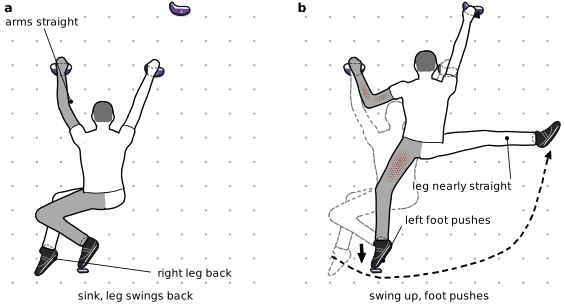
You swing your free leg like a pendulum towards the target. At the right moment you push off your one low foothold. The leg swing carries you to a hold that is out of reach.
Grade Gyms rarely force pogos [240], though they appear more on competition-style problems from about V5–V6. Static climbers who are strong on small edges rarely use them [233].
How to do it
Put both hands on the start holds and one foot on a low foothold. Here it is the left. Your right leg hangs free [240].
For the back-swing, straighten your arms. Sink as low as you can while the free leg swings back [240].
Swing the free leg forward and up towards the target. Keep it as straight as you can. A long lever builds more speed [240].
Lead with your hips. Aim your centre of gravity (your body’s balance point) at the target [219, 240].
Halfway through the leg swing, push off the standing foot. Pull with your arms at the same time [240].
Catch with the hand on the same side as the swinging leg. The arc lifts your legs. Hold your shoulders firm and stay tight [240].
Figure 80 (a) Sink on straight arms and swing the right leg back. (b) Swing it forward and up while the left foot pushes. The right hand goes for the hold.
Common mistakes
Jumping hard as you would for a dyno. A pogo is quick but less violent [240].
Tall climbers. Long legs make a longer lever, which helps here [240]. On low starts, check that your swinging foot clears the mats and any volume behind you.