Also called drag, open grip, three-finger drag, chisel, offene Hand · Hands and holds
You hang your finger pads over the hold with the joints only slightly bent. Skin friction and the long finger tendons do the work. It is the cheapest grip and puts far less load on your finger pulleys than a crimp [167, 174].
Grade It matters from V2, when edges get rounded. In Lattice’s tests at V1–V4, climbers added 22.5 kg in open hand and 14.5 kg in half crimp. They were different climbers, so this only hints at a natural strength [169].
How to do it
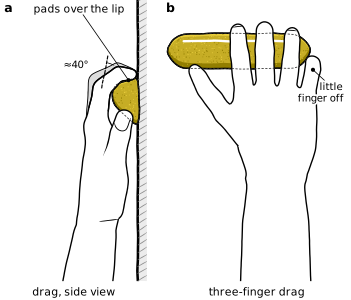
Lay your finger pads over the lip (the front of the hold). The end joint hooks over it [167].
Keep the middle joint only slightly bent. Measured open-hand grips average about 40° there [175].
Choose four fingers or three. In a three-finger drag, the little finger comes off [167, 176].
Keep your wrist slightly bent back. It gives your finger muscles better leverage [171].
Hang below the hold on a straight arm. The pull then runs down through the pads.
Figure 52 (a) Drag on a rounded edge: the pad drapes over and the middle joint bends about 40°. (b) Three-finger drag seen from behind, with the little finger off.
Common mistakes
Starting in a crimp and letting it be forced open under full load. Hooper’s Beta links this to pulley tears [172]. Choose the open hand before you load the hold.
Leaving the little finger off when it could help. It matters more in better climbers [177].