Also called closed crimp, crimping, thumb lock, voll aufgestellt · Hands and holds
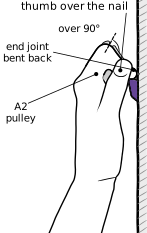
The middle joints bend past 90° and the end joints bend backwards. The thumb often locks over the index fingernail. It is the most secure grip on tiny edges, but it puts very high loads on the finger pulleys[161, 167, 171].
Grade From V5, holds get “smaller and crimpier” [170]. Some tiny edges then work only with a full crimp.
How to do it
Put your fingertips on the edge. Lift your knuckles until the middle joints bend past 90°. The end joints bend back.
Lock your thumb over the index fingernail [167, 171]. It adds force without loading the other fingers more [198].
Bring your palm close to the wall. It gets you further behind an incut edge [176].
Use it for the hard move only. Go back to a half crimp or open hand on the next hold.
Keep your feet solid. A foot slip jolts the fingers hard [162, 174].
Figure 65 Full crimp from the side, the thumb locked over the index fingernail. The middle joint bends past 90° and the end joint bends back. The load on the A2 pulley is particularly high.
Common mistakes
Full crimping holds big enough for a half crimp or open hand [171].